
1.2 GPM Basin Faucets: Flow Rate, WaterSense and the Hand-Wash Problem
The flow figure cleared the credit. On paper a 1.2 GPM basin mixer met the project's water-use target, and the submittal went through. At the mock-up the user turned on the tap, cupped their hands under the stream, and water bounced off the basin rim onto the counter. The number was correct. The basin had not been part of the calculation.
A flow rate is a rate at a stated pressure, not a description of how water behaves in a particular bowl. Gallons per minute says how much water leaves the spout under a defined test condition; it says nothing about the shape of the stream, the height it falls from, the depth of the basin below it, or how long someone needs to run it to rinse soap off their hands.
This is where a submittal can be misleading: a low-flow figure can be accurate and still splash on a shallow bowl or leave a sensor tap cycling while the user waits. The same 1.2 GPM basin faucet behaves differently in two washrooms with different supply pressures and basin geometry.
Conditions That Change the Number
Before comparing a flow rating to a user complaint, fix the conditions around it. The table below separates what the rate specifies from what the installation decides.
Basin condition | Flow behaviour | Specification adjustment |
Shallow, wide basin | Coherent stream rebounds off the flat bottom and splashes | Softer aerated stream, shorter spout reach, lower exit velocity |
Deep, narrow basin | Stream loses energy in the bowl; less splash, slower perceived fill | Aerator choice driven by rinse feel rather than splash |
Spout outlet close to the rim | Small drop height, hands crowd the outlet | Increase spout height or reach; confirm clearance on the drawing |
Low supply pressure at the fixture | A fixed orifice falls below its rating; pressure-compensating control holds it | Specify pressure-compensating flow control and verify at site pressure |
High or fluctuating supply pressure | Rate rises unless regulated; mixing valves hunt | Confirm upstream pressure and balancing before the flow test |
Sensor-activated fixture | Activation delay and run-on time add volume per use | Set sensitivity and run-on during commissioning |
Hard water or debris | Aerator screen blocks and the stream becomes uneven | Specify a cleanable aerator and a maintenance interval |
Flow Rate Is a Pressure-Dependent Number
A figure in GPM is meaningless without the pressure at which it was measured. For North American fixtures, flow figures are commonly quoted at a stated test pressure — often 60 psi in general practice — and the method is set out in ASME A112.18.1 / CSA B125.1, the plumbing fixture fittings standard covering construction and performance testing of supply fittings, including flow rate. A submittal should say which test condition and which revision the figure comes from. A rating quoted without a pressure is a marketing number, not a comparable specification.
Two consequences follow for a 1.2 GPM basin faucet. The delivered rate depends on the pressure at the fixture, which is a function of the building supply, the floor, the pipe run and any upstream pressure-reducing valve. A fixed-orifice restrictor passes less than its rating at low pressure and more at high pressure; a pressure-compensating regulator is designed to hold closer to its rating across a range. And the figure is for the fitting, not the system: a partly closed stop, a clogged aerator or a long flexible supply line can move the delivered rate without anything being wrong with the faucet.
That puts the flow test at commissioning, at the fixture, with the pressure recorded at the same time. Measuring flow on a bench and assuming the installed value is a common source of the "the tap is weaker than the sample" complaint. The plumbing engineer should also confirm whether the local code sets its own maximum flow for the fixture type; where it does, the spec has to satisfy both the code and the design target.
Compliance documentation runs alongside the flow figure rather than inside it. cUPC is the North American plumbing product certification mark administered by IAPMO, and NSF/ANSI 61 addresses the drinking water system components the fitting contacts. The company lists cUPC and NSF/ANSI 61 among its certifications, alongside CE, ISO 9001, California AB1953 and Australian DZR brass compliance, with WRAS and ACS named for Europe and the UK. Each answers a different question — a flow rating is not a material safety certificate. A buyer reviewing basin faucet compliance should ask for the files against the exact model and finish ordered.
Aerators, Laminar Flow and the Shape of the Stream
At a fixed rate, the character of the stream decides whether the fixture feels adequate. An aerator mixes air into the water, producing a wider, softer, opaque stream that wets the hands over a larger area and loses velocity quickly. A laminar device produces a clear, coherent stream with little entrained air. Both can be built to the same GPM, yet they behave differently at the basin: an aerated stream tends to splash less on a shallow bowl, while a laminar stream stays intact over a longer drop and can rebound sharply off a hard surface. Low flow faucet splash and rinse complaints are often a stream-shape problem rather than a volume problem.
A flow restrictor and an aerator are not the same component. A restrictor limits the rate — a fixed orifice, a flexible insert that deforms under pressure, or a pressure-compensating regulator. The aerator is the outlet device that shapes the stream and catches debris. Many fittings combine both in one threaded insert. Swapping an aerator can change the delivered rate as well as the feel, so the two should be specified together by part number. A buyer who orders a "1.2 GPM" faucet without naming the outlet device has left the most visible part of the specification open.
Spout reach and basin depth
Geometry is the other half of the problem. Spout height and reach set the drop distance between the outlet and the basin floor, and the basin's depth and curvature decide what the stream hits. A tall vessel basin and a shallow countertop bowl can both be paired with the same 1.2 GPM basin faucet, with opposite results. The distance from the outlet to the basin, the position of the waste outlet and the slope of the bowl should be on the drawing before the faucet is selected, along with the clearance for hands under the spout.
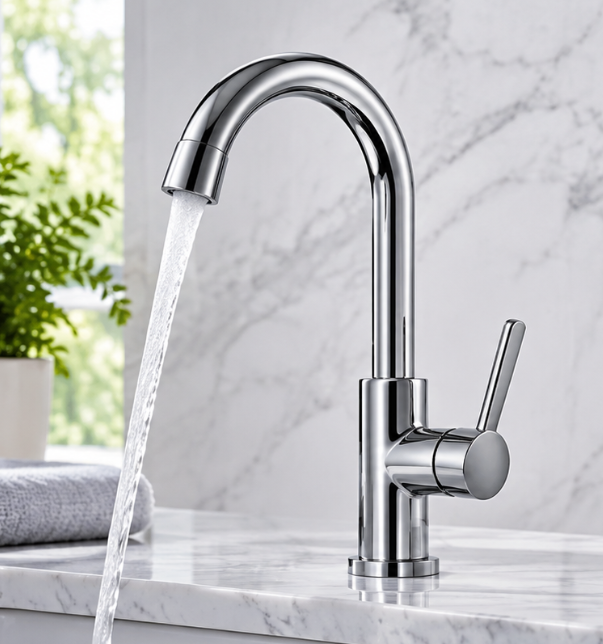
The single-handle basin mixer collection is a useful place to see the variables together: handle position, spout geometry and outlet device are fixed by the same body. Changing any of them for a coordinated collection is a re-selection, not a finish change.
WaterSense and the LEED Water-Use Credit
The company states that its basin faucets are engineered for 1.2 GPM LEED compliance. That is a design target tied to a green building credit, worth separating from the label a retail buyer may look for. EPA WaterSense is a voluntary labelling programme for water-efficient products; a WaterSense labelled faucet has been certified against the programme's criteria and appears in its product listings. The specific flow criterion and test method should be read from the EPA WaterSense site rather than quoted from memory, and a buyer should check the current listing for the exact model instead of assuming a catalogue claim transfers to it.
LEED works differently. Its water-use reduction credit is documented by calculating the baseline and design water use of the fixtures in a project, with the plumbing engineer recording the calculation in the credit submittal. A 1.2 GPM basin faucet is a number that goes into that calculation; it is not itself a certification of the building. The fixture flow rate, the number of fixtures, the assumed use pattern and any other water-using equipment all feed the credit. Two projects can specify the same faucet and reach different results.
That is the gap the mock-up exposed. The credit is calculated from a rate; the user experiences a stream. Consider a typical commercial washroom fit-out: a project team selects a low flow basin mixer for the water-use credit, approves the cut sheet, and only at the mock-up discovers that a shallow bowl and a coherent stream produce splash across the counter. Nothing in the credit calculation would have caught it, because the calculation does not contain a basin dimension.
Fix the credit requirement and the user requirement at the same time: choose the rate, then choose the outlet device, spout geometry and basin that make that rate usable, then document the result for the credit. If those decisions are made by different people, the plumbing engineer should own the interface between them.
Sensor Activation, Manual Handles and Commissioning
Activation changes the volume per use without changing the rated flow. A manual handle starts and stops with the user. A sensor faucet adds a detection delay, a run-on time after the hands leave, and the possibility of false triggers from a reflective basin or a nearby mirror. At 1.2 GPM those seconds are a small but real part of the water used per visit, and they are set during commissioning rather than at the factory. Sensor sensitivity, run-on time and any automatic shut-off should be recorded as settings in the O&M manual.
Manual fixtures have their own commissioning items. Stop valves under the basin are frequently left partly closed after installation, reducing the delivered rate below the submittal figure and mimicking a defective faucet. Mixing valves and supply temperature affect how long a user runs the tap to reach a comfortable temperature. On a project with long pipe runs or pressure imbalance between floors, the rate measured at one fixture may not describe another. A short on-site check — measure flow and record pressure at a sample of fixtures, with the aerator fitted — catches most of these before handover.
The company's categories cover basin, shower, kitchen and accessory ranges, and its kitchen faucet line is specified for heavy-duty operational environments with magnetic docking and burst-proof PEX supply lines. Those are different duty cycles from a basin mixer; a rate that works at a hand-wash basin should not be carried over to a kitchen sink or a shower without re-checking the use case.
Questions the Plumbing Engineer Will Ask
Does 1.2 GPM mean the tap will always deliver 1.2 GPM?
No. It is a rated value at a stated test pressure. The delivered rate depends on the pressure at the fixture, the condition of the stops and the aerator, and whether the flow control is pressure-compensating. Measure at the fixture during commissioning and record the pressure alongside the reading.
Is a WaterSense label the same as a 1.2 GPM LEED target?
No. A WaterSense labelled faucet is one certified to that programme's criteria and listed in its product registry. A 1.2 GPM LEED target is a design figure that feeds a project water-use calculation. Both can apply to the same fitting, but they are documented differently — one through a product listing, the other through the credit submittal.
Can a flow restrictor be removed if the pressure is low?
A restrictor is part of the rated configuration, and removing it changes the certified flow rate and the documentation behind it. If the delivered rate is low, check the stops, the aerator screen and the site pressure first. Altering the flow control should go through the engineer rather than the installer.
Why does the stream splash when the flow is low?
Splash is mostly about stream shape and drop height, not volume. A coherent laminar stream hitting a shallow basin at short range rebounds; an aerated, softer stream tends to break up. Fix the outlet device, spout geometry and basin depth together — a lower flow alone does not guarantee a drier counter.
What to Confirm With the Engineer and the Local Code
Before a 1.2 GPM basin faucet is written into an RFQ or a project sign-off, fix the following, because each changes whether the rated number describes what gets installed:
· The test pressure and standard the flow rating is quoted against, with the model and outlet device identified by part number.
· Basin geometry: depth, curvature, waste position, spout height, spout reach and clearance for hands under the outlet.
· Supply conditions at the fixture: static and residual pressure, balancing arrangements and any upstream pressure-reducing valve.
· Activation method and, for sensor fixtures, sensitivity, run-on and automatic shut-off settings recorded at commissioning.
· The compliance set for the target market: cUPC and NSF/ANSI 61 for North America, WRAS for the UK, and any maximum flow the local code sets.
· The credit documentation: which LEED calculation the 1.2 GPM figure feeds, and who records fixture count and use assumptions.
· A commissioning check measuring flow and pressure at installed fixtures with the final aerator fitted, and a revision rule for any change of basin, spout or outlet device.
The last two items are where a low-flow specification usually comes apart. A basin faucet compliance file can be complete, the credit calculation correct, and the fitting still wrong for the bowl it is mounted over. Confirm the rate, the geometry and the code together, and the 1.2 GPM basin faucet becomes a specification that works both on the submittal and at the sink.