
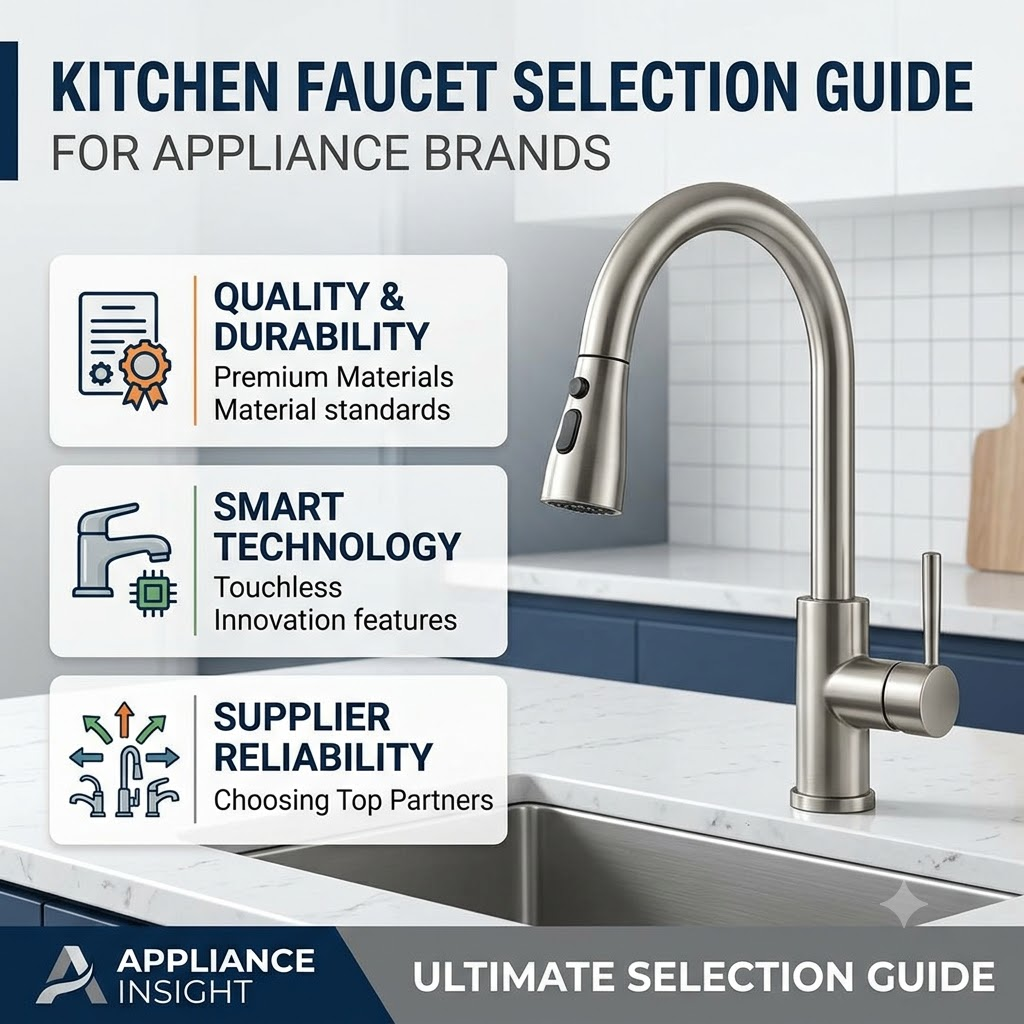
How to Select a High Quality Kitchen Faucet for Your Home Appliance Brand?
Introduction: The Faucet Behind the Kitchen Experience
When people talk about kitchen upgrades, they usually mention cabinets, countertops, or appliances first.
The faucet? It often gets overlooked.
But after working with kitchen hardware manufacturers and home appliance brands for years, I can say one thing: a kitchen faucet is one of the most frequently used products in a home. It is touched dozens of times every day, exposed to water, cleaning chemicals, temperature changes, and constant mechanical movement.
A poor-quality faucet does not usually fail on day one. That would be easy to notice.
The real problem appears months later:
· The handle becomes loose.
· The cartridge starts leaking.
· The surface finish fades.
· The water flow becomes inconsistent.
· Customers begin leaving negative reviews.
For a home appliance brand, this is not just a product issue. It affects brand reputation.
Choosing the right Kitchen Faucet Manufacturer and developing a reliable Custom Kitchen Faucet solution requires more than checking appearance or factory price. Material selection, internal structure, production standards, and long-term durability all matter.
A good kitchen faucet should look attractive, but it also needs to perform quietly for years.
That is where professional sourcing decisions make the difference.
Table of Contents
1. Understanding What Makes a Kitchen Faucet High Quality
2. Key Components That Determine Faucet Performance
3. Choosing the Right Materials for Kitchen Faucet Production
4. Manufacturing Quality Standards and Factory Capability
5. Custom Kitchen Faucet Development for Home Appliance Brands
6. Important Parameters Buyers Should Evaluate
7. Real Industry Case Study: How Product Quality Builds Brand Trust
8. Common Mistakes When Selecting a Kitchen Faucet Manufacturer
9. Frequently Asked Questions
10. Final Thoughts
1. Understanding What Makes a Kitchen Faucet High Quality
A kitchen faucet looks simple from the outside, but internally it is a precision product.
A modern kitchen faucet combines:
· Mechanical engineering
· Water flow control technology
· Material science
· Surface finishing technology
The basic working principle is straightforward.
When users move the handle, the internal cartridge controls the mixing of hot and cold water. The cartridge regulates water volume and temperature, while the aerator controls the final water stream.
Simple, right?
Yes. But the details decide whether the product lasts five years or starts causing problems after six months.
A high-quality kitchen faucet normally focuses on several areas:
Water Control Stability
The internal valve system needs to provide smooth operation.
A good cartridge should:
· Maintain consistent water flow
· Resist wear from repeated movement
· Prevent leakage over long-term use
Ceramic cartridges are widely used in premium faucets because ceramic materials offer excellent wear resistance.
Structural Strength
The faucet body carries continuous pressure from the water supply system.
A weak body structure may cause:
· Cracks
· Deformation
· Connection failures
This is why material selection matters so much.
User Experience
Modern buyers expect more than basic functionality.
They look for:
· Smooth handle movement
· Comfortable spray modes
· Easy cleaning
· Quiet operation
· Good appearance matching kitchen design
A faucet is no longer only a plumbing product. It has become part of the kitchen lifestyle.
2. Key Components That Determine Faucet Performance
When evaluating a kitchen faucet supplier, buyers should understand the internal components.
Many purchasing mistakes happen because people only compare external appearance.
The outside can look almost identical.
The difference is usually inside.
2.1 Faucet Cartridge
The cartridge is often considered the “heart” of the faucet.
It controls:
· Water temperature
· Water flow
· Opening and closing movement
Common cartridge types include:
· Ceramic disc cartridge
· Compression cartridge
· Ball valve cartridge
For modern residential kitchens, ceramic cartridges are widely preferred because they provide smoother operation and better durability.
2.2 Faucet Body
The faucet body is usually manufactured from:
· Brass
· Stainless steel
· Zinc alloy
The material directly affects:
· Corrosion resistance
· Strength
· Service life
A professional Kitchen Faucet Manufacturer should clearly define material specifications instead of only promoting appearance.
2.3 Aerator and Spray System
The aerator affects the water experience.
A good aerator can:
· Reduce splashing
· Improve water flow consistency
· Reduce unnecessary water consumption
Some advanced faucets include:
· Pull-down spray heads
· Multiple spray modes
· Magnetic docking systems
These features have become popular in modern kitchens.
3. Choosing the Right Materials for Kitchen Faucet Production
Material selection is one of the first questions professional buyers should ask.
Different materials create different product positioning.
The table below shows common options.
Material | Advantages | Limitations | Typical Application |
Brass | Strong, durable, excellent machining performance | Higher material cost | Premium kitchen faucets |
Stainless Steel 304 | Good corrosion resistance, hygienic, modern appearance | More difficult processing | Mid-to-high-end products |
Zinc Alloy | Lower cost, easy forming | Lower durability compared with brass | Entry-level faucets |
Plastic Components | Lightweight and economical | Limited strength | Internal accessories |
For brands targeting long-term market growth, brass and stainless steel are usually preferred.
Why?
Because customers may not see the material, but they definitely experience the result.
A faucet with poor material quality often creates after-sales problems.
4. Manufacturing Quality Standards and Factory Capability
Choosing a reliable Kitchen Faucet Manufacturer is not only about production capacity.
A factory needs technical control.
4.1 Casting and Machining Control
For brass faucets, casting quality directly affects reliability.
Manufacturers need to control:
· Material purity
· Casting defects
· Wall thickness
· Internal structure
Poor casting may create hidden problems such as internal holes or weak areas.
These issues are difficult to discover during visual inspection.
4.2 Surface Finishing Technology
The surface finish is one of the first things customers notice.
Common finishes include:
· Chrome plating
· Matte black coating
· Brushed nickel
· PVD coating
Premium brands often use PVD technology because it provides:
· Better scratch resistance
· More stable color performance
· Improved surface durability
4.3 Testing Before Shipment
A professional factory should perform testing such as:
· Water pressure testing
· Leakage testing
· Salt spray testing
· Functional testing
· Surface inspection
For international markets, products may also need to meet regional standards.
Examples include:
· NSF certification requirements in North America
· WRAS requirements in the UK market
· CE-related requirements for European markets
5. Custom Kitchen Faucet Development for Home Appliance Brands
Many home appliance companies today are moving toward private label and product differentiation.
This is where Custom Kitchen Faucet solutions become valuable.
Instead of selling a standard product available everywhere, brands can create products with:
· Unique appearance
· Customized functions
· Specific packaging
· Brand identity
5.1 What Can Be Customized?
Depending on the manufacturer’s capability, customization may include:
Design
· Faucet shape
· Handle style
· Spray head structure
· Finish color
Function
· Pull-down design
· Touchless sensor control
· Water-saving technology
· Filter integration
Branding
· Logo marking
· Packaging design
· Instruction manuals
5.2 Why Customization Matters for Brands
The kitchen hardware market is competitive.
Many products look similar.
A customized faucet helps brands create differentiation.
For example:
A company selling smart kitchen appliances may develop a faucet with:
· Matching industrial design
· Smart water control features
· Coordinated product packaging
The faucet becomes part of a complete kitchen ecosystem.
6. Important Parameters Buyers Should Evaluate
Before placing a large order, professional buyers should review technical information carefully.
Important parameters include:
Parameter | Why It Matters |
Material specification | Determines durability |
Cartridge type | Influences operation life |
Working pressure | Ensures safety |
Surface treatment | Affects appearance durability |
Testing standard | Confirms reliability |
MOQ requirement | Impacts inventory planning |
Customization capability | Supports brand development |
7. Real Industry Case Study: How Quality Builds Brand Trust
A good example can be seen from the growth of premium kitchen fixture brands such as Kohler.
The company has built its reputation not only through design but also through product reliability, engineering development, and consistent manufacturing quality.
According to the U.S. Environmental Protection Agency WaterSense Program, WaterSense labeled products are designed to use at least 20% less water while maintaining performance compared with standard models.
This shows an important market trend:
Customers increasingly care about both experience and efficiency.
For appliance brands entering the kitchen category, faucet development is moving beyond basic hardware.
A successful product needs:
· Reliable engineering
· Attractive design
· Responsible water usage
· Consistent quality
8. Common Mistakes When Selecting a Kitchen Faucet Manufacturer
Many buyers focus heavily on unit price.
This is understandable.
But the lowest quotation is not always the lowest total cost.
Common mistakes include:
Choosing Based Only on Appearance
Two faucets can look almost identical externally but have completely different internal quality.
Always evaluate:
· Cartridge
· Material
· Testing process
Ignoring Production Consistency
A factory may provide a good sample.
The bigger question is:
Can they maintain the same quality for 5,000 or 50,000 units?
Production stability matters.
Not Considering After-Sales Issues
A cheaper product with higher failure rates can damage a brand.
Warranty claims, returns, and customer complaints all create hidden costs.
9. Frequently Asked Questions (FAQ)
Q1: What material is best for a kitchen faucet?
For premium kitchen faucets, brass and stainless steel 304 are commonly preferred because they provide good durability and corrosion resistance.
The best choice depends on target market, price positioning, and product requirements.
Q2: How do I choose a reliable Kitchen Faucet Manufacturer?
Look for manufacturers with:
· Stable production experience
· Quality control systems
· Testing capability
· Custom development support
· International export experience
A supplier should be able to explain both product design and manufacturing processes.
Q3: Is a Custom Kitchen Faucet more expensive?
Usually, customized products require higher initial development costs.
However, customization can provide advantages:
· Better brand differentiation
· Higher customer recognition
· Stronger market positioning
For brands building long-term value, customization is often worth considering.
Q4: How long should a quality kitchen faucet last?
A well-manufactured kitchen faucet can provide many years of service when properly installed and maintained.
Actual lifespan depends on:
· Material quality
· Water conditions
· Usage frequency
· Manufacturing standards
Final Thoughts: Selecting the Right Faucet Partner Matters
A kitchen faucet may be a small product in size, but it represents a major touchpoint between a brand and its customers.
For home appliance companies, choosing the right Kitchen Faucet Manufacturer is not simply about finding a supplier.
It is about finding a manufacturing partner who understands:
· Product quality
· Market expectations
· Design requirements
· Long-term brand value
A successful Custom Kitchen Faucet project combines engineering, manufacturing control, and customer-focused design.
The best products are not always the ones with the most features.
Usually, they are the ones that work smoothly every day, quietly, for years.
That is the standard brands should aim for when developing their next kitchen product line.