
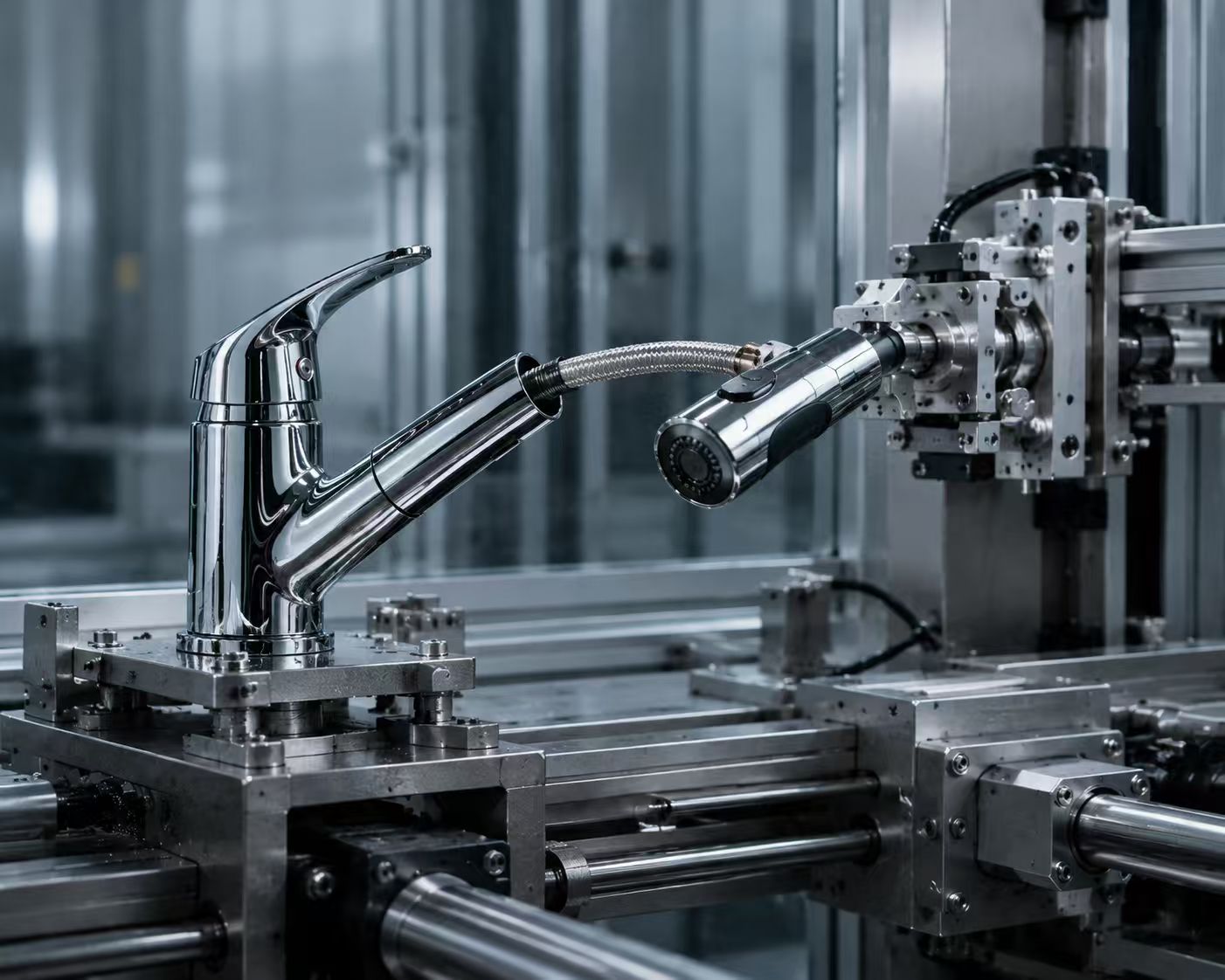
Testing 50,000 Pull Cycles: How High-End Factories Guarantee the Lifespan of Retractable Kitchen Taps
Introduction
In the specification of kitchen fittings for residential and hospitality projects, the durability of retractable mechanisms is a performance attribute that is frequently cited but rarely understood in technical depth. The claim of "50,000 pull cycles" appears on product datasheets and marketing materials with increasing frequency, yet the testing protocols, acceptance criteria, and engineering principles that underpin this figure remain opaque to most specifiers and procurement professionals.
For a retractable kitchen tap—a device that is pulled, extended, retracted, and swiveled thousands of times over its service life—the mechanical endurance of its moving components is not merely a convenience feature. It is a fundamental determinant of the product's functional lifespan and, by extension, the lifecycle cost of the installation. A tap that fails to retract smoothly, develops play in its swivel joint, or suffers hose kinking after 10,000 cycles is not simply an inconvenience—it represents a premature failure that incurs replacement costs, user dissatisfaction, and reputational risk for the specifying brand or developer.
This article examines the technical basis of the 50,000-cycle endurance test for retractable kitchen taps, the relevant standards and test protocols, the specific components subjected to such testing, and the engineering practices that enable high-end factories to consistently achieve—and often exceed—this performance benchmark.
The Standards Framework: Defining the Baseline
The durability requirements for retractable kitchen taps are not arbitrary. They are defined by a hierarchy of international and regional standards that establish minimum performance criteria for different components and use scenarios.
ASME A112.18.1: The North American Benchmark
In the North American market, the applicable standard for plumbing supply fittings is ASME A112.18.1. This standard establishes performance requirements and test procedures for a wide range of fittings, including kitchen faucets with retractable spray heads. The industry standard for cycle life is based on ASME A112.18.1 of 500,000 cycles for valve and cartridge endurance. This figure is widely cited by major manufacturers as the benchmark against which their proprietary sealing technologies are measured.
The 500,000-cycle requirement applies primarily to the valve mechanism—the ceramic disc cartridge that controls flow and temperature. This endurance test simulates years of daily use, with each cycle representing one opening and closing of the valve. For a typical residential kitchen, 500,000 cycles equates to approximately 13 years of service at 100 cycles per day.
EN 817: The European Standard
In Europe, the applicable standard for mechanical mixing valves is EN 817. The 2024 revision of this standard, published in September 2024, updated hydraulic performance requirements, acoustic characteristics, and sealing test methods, and introduced durability testing for single-sequence control devices. Durability testing under EN 817 is divided by control type, ranging from 70,000 to 200,000 cycles, with test conditions including a rotation speed of approximately 60°/s and alternating hot and cold water supply.
For retractable kitchen taps, the endurance of the pull-out mechanism and diverter is often specified at 50,000 cycles in addition to the valve endurance requirements. This represents a distinct test regime targeting the mechanical components specific to retractable designs.
EN 16146: The Pull-Out Hose Standard
The hose assembly in a retractable kitchen tap is subject to its own dedicated standard. EN 16146:2012+A1:2014 specifies technical requirements for hoses used in pull-out kitchen faucets for Type 1 and Type 2 water supply systems. This standard covers marking, hydraulic performance, and rotational connection devices, and includes specific test methods for hose pull-out durability.
The endurance requirements for pull-out hoses under this standard typically include cyclic flexibility testing, where the hose is repeatedly bent through a specified arc or around a mandrel for thousands of cycles to simulate years of use, with monitoring for cracks, kinks, or reduced performance. For high-quality hoses, a cycle life expectation of 50,000 cycles or more is typical.
The 50,000-Cycle Test: Components and Protocols
The 50,000-cycle endurance figure appears in product specifications across multiple components of a retractable kitchen tap. Understanding which components are tested—and under what conditions—is essential for evaluating product claims.
The Diverter (Spray Mode Switch)
The diverter is the mechanism that switches the spray head between different flow modes—typically a standard aerated stream and a spray pattern. This component is subjected to repeated actuation throughout the product's life, and its failure results in loss of function or mode switching.
High-end manufacturers explicitly test the diverter to 50,000 cycles. JUSTIME, a Taiwanese manufacturer, specifies that the diverter of its sprayer has passed a 50,000-times lifespan test. The same manufacturer applies the 50,000-cycle test to the swiveling spout, ensuring that the rotational mechanism endures the same number of cycles. This dual testing—both the diverter and the swivel mechanism—demonstrates a comprehensive approach to endurance validation.
The diverter test protocol typically involves automated cycling of the switch mechanism under conditions that simulate actual use, including the presence of water flow and pressure. The acceptance criterion is the maintenance of proper sealing and mode switching without leakage or degradation of actuation force.
The Pull-Out Hose
The pull-out hose is perhaps the most mechanically stressed component in a retractable kitchen tap. Each extension and retraction subjects the hose to bending, flexing, and axial loading. Over thousands of cycles, the cumulative mechanical fatigue can lead to kinking, cracking, or loss of retraction force.
High-quality retractable taps use hoses constructed from materials such as nylon braided with an EPDM or SANTOPRENE inner tube. JUSTIME specifies a SANTOPRENE inner tube that meets NSF approval and can withstand 10 kg/cm² water pressure and 120°C heat. The hose is designed to extend approximately 30 cm and retract automatically to its original position.
Cyclic flexibility testing for pull-out hoses involves repeatedly bending the hose through a specified arc for thousands of cycles, monitoring for cracks, kinks, or reduced performance. The internal hose typically undergoes over 10,000 bending cycles in rebound tests to ensure long-term use without collapse or failure to return to its original position. For premium products, the expectation is 50,000 cycles or more.
The Swivel Spout
Many retractable kitchen taps feature a spout that swivels—typically 360 degrees—to extend the reach of the water stream across the sink. This rotational mechanism is subjected to repeated use and must maintain smooth operation without developing play or leakage.
The swivel spout is tested for endurance, with 50,000 turns being a common benchmark. JUSTIME specifies that its swiveling spout has passed up to 50,000 turns test. The test protocol involves automated rotation of the spout through its full range of motion under conditions that simulate actual use, with monitoring for smooth operation, sealing integrity, and mechanical wear.
The Valve Cartridge: Beyond 50,000 Cycles
While 50,000 cycles is the benchmark for the mechanical components specific to retractable designs, the valve cartridge—the heart of the tap's flow and temperature control—is tested to a significantly higher endurance standard. The industry standard, as defined by ASME A112.18.1, is 500,000 cycles.
High-quality ceramic disc cartridges are tested to this endurance level across the industry. Manufacturers specify cartridges that have passed 500,000 opening and closing cycles. The test simulates the full range of handle operation—from fully closed to fully open—under both hot and cold water supply conditions.
The endurance of the ceramic cartridge is a critical factor in the tap's overall lifespan. A cartridge that fails before its rated cycle life will result in dripping, reduced flow, or complete loss of function. The 500,000-cycle benchmark, when achieved, provides a high degree of confidence in the long-term reliability of the flow control mechanism.
The Engineering Practices That Enable 50,000 Cycles
Achieving consistent 50,000-cycle performance across production volumes requires more than simply specifying the right materials. It demands disciplined engineering practices across design, material selection, manufacturing, and quality control.
Material Selection
The choice of materials directly influences endurance. For the hose, materials such as SANTOPRENE—a thermoplastic vulcanizate—offer the combination of flexibility, heat resistance, and durability required for high-cycle applications. Nylon braiding provides additional mechanical strength and resistance to kinking. For the diverter and swivel mechanisms, brass construction with chrome plating provides the necessary mechanical strength and corrosion resistance, with SC2 standard of ASTM and 96-hour salt spray testing ensuring finish durability.
Precision Manufacturing
The moving components of a retractable tap—the diverter, the swivel mechanism, the hose connections—must be manufactured to tight tolerances to ensure consistent performance over thousands of cycles. CNC machining of brass components and precision assembly of the cartridge and diverter are essential to achieving the required fit and function.
Automated Testing
High-end factories employ automated testing systems to validate endurance performance. These systems cycle the diverter, swivel, and pull-out mechanism through the required number of cycles under controlled conditions, monitoring for failure points and degradation. The use of automated testing ensures consistency and repeatability, and provides data for continuous improvement.
Quality Control and Certification
Endurance testing is typically conducted as part of type approval testing—laboratory testing that validates the design's compliance with standards. In addition to type approval, factories implement factory production control (FPC) to ensure that production units meet the same standards. Certifications such as cUPC, NSF, and AB1953 provide independent verification of compliance with applicable standards.
Procurement Implications
For specifiers and procurement professionals, the presence of 50,000-cycle testing on a product datasheet is not by itself a guarantee of quality. The following factors should be considered when evaluating product claims:
Scope of testing. Does the 50,000-cycle claim apply to the diverter only, or does it also cover the swivel spout and the pull-out hose? A comprehensive testing program covers all moving components.
Test conditions. Are the test conditions representative of actual use? The presence of water flow, pressure, and temperature during testing is essential for realistic validation.
Standards compliance. Does the product comply with applicable standards such as ASME A112.18.1, EN 817, or EN 16146? Compliance provides a baseline of performance that is independently verified.
Material quality. What materials are used for the hose, the diverter, and the swivel mechanism? SANTOPRENE or EPDM hoses with nylon braiding are indicators of quality.
Certification. Does the product carry cUPC, NSF, or other independent certifications? These provide assurance that the product has been tested by an accredited laboratory.
Conclusion
The 50,000-cycle endurance test for retractable kitchen taps is not a marketing invention—it is a technically grounded validation of the mechanical durability of the tap's moving components. The diverter, the pull-out hose, and the swivel spout are each subjected to rigorous cycling tests that simulate years of actual use. When combined with the 500,000-cycle endurance requirement for the ceramic disc cartridge—as defined by ASME A112.18.1—the result is a comprehensive validation of the tap's functional lifespan.
For high-end factories, achieving consistent 50,000-cycle performance is the result of disciplined engineering: careful material selection, precision manufacturing, automated testing, and rigorous quality control. For specifiers and procurement professionals, understanding the technical basis of these claims enables more informed purchasing decisions and better lifecycle cost management.
The tap that performs smoothly after 50,000 pulls is not a product of chance—it is a product of engineering intent.